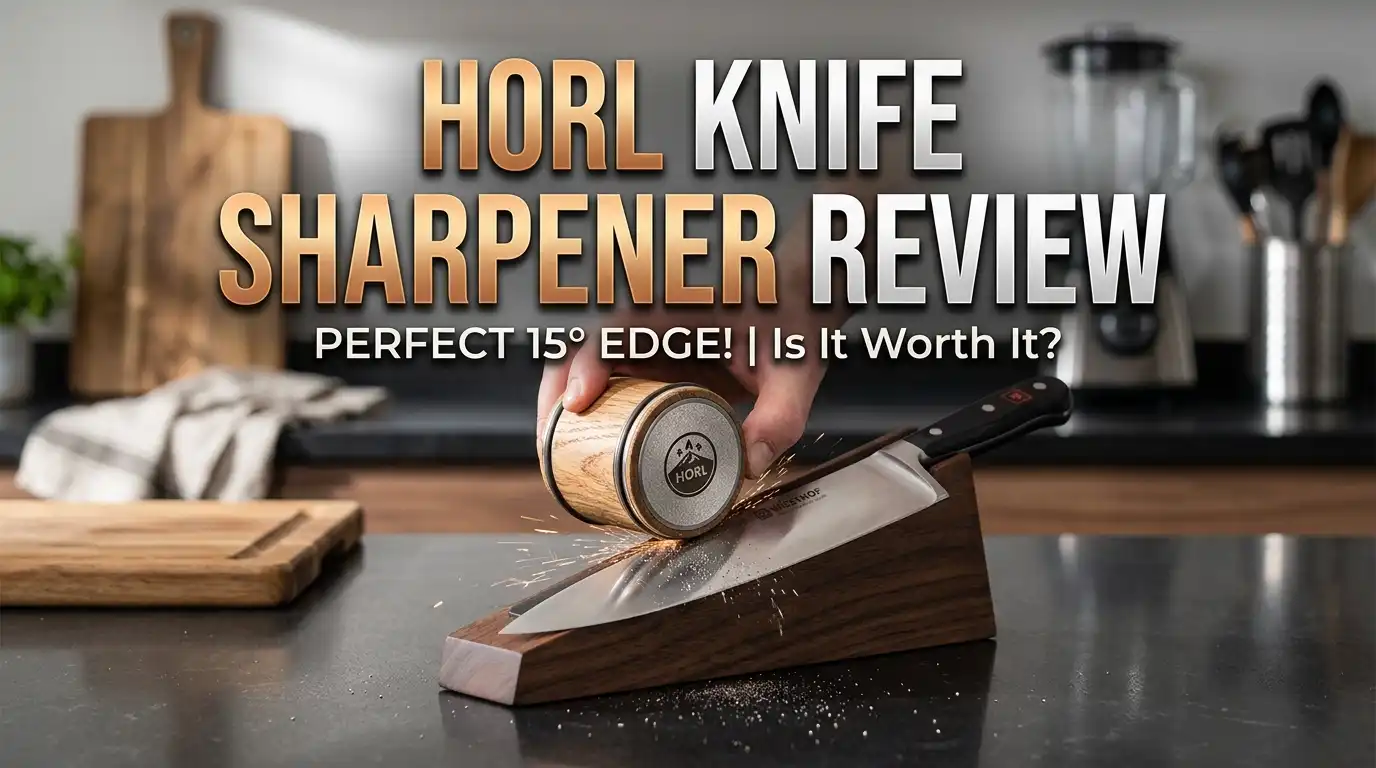
Horl Knife Sharpener Review: Rolling Sharpener Worth the Hype?
Dull knives are frustrating. They slip on food, crush tomatoes, and make every kitchen task harder than it needs to be. Most home cooks know they should sharpen their knives regularly.
But whetstones feel intimidating, electric sharpeners eat too much metal, and professional sharpening adds up fast. That’s where the Horl knife sharpener enters the picture. This German-engineered rolling sharpener has taken the kitchen world by storm, promising razor-sharp results without the learning curve. But does it actually deliver?
I’ve spent months testing this sharpener on dozens of knives to find out. In this detailed Horl knife sharpener review, I’ll break down everything from build quality to sharpening performance, and help you decide if it’s worth the investment. Keep reading to get the full picture before you spend your money.
Key Takeaways: Horl Knife Sharpener In A Nutshell
- The Horl knife sharpener uses a rolling design with a magnetic angle block and a cylindrical sharpening roller. This two-piece system removes the guesswork from maintaining the correct sharpening angle. You get consistent results every single time.
- It works on both Japanese and Western knives. The magnetic angle support offers a 15-degree angle for Japanese-style blades and a 20-degree angle for European kitchen knives. This dual-angle design makes it one of the most versatile rolling sharpeners available.
- Sharpening takes about 4 minutes per knife. You roll the diamond grinding disc along each side of the blade, then follow up with the ceramic honing disc. The process is quick, clean, and requires no water or oil.
- The Horl sharpener does not replace a whetstone for advanced users. Professional sharpeners and knife enthusiasts will still get better results from a full set of whetstones. The Horl closes the gap significantly, though, delivering what experts call a B+/A- level of sharpness.
- Build quality is excellent but the price is high. The Horl 2 costs around $189 for the oak version. It’s a premium tool made in Germany with quality materials. You should expect years of use from it.
- It’s ideal for home cooks who rarely sharpen their knives. If your knives have been dull for months, this sharpener will change your kitchen experience. It makes the task simple enough that you’ll actually do it regularly.
What Is The Horl Knife Sharpener?

- The HORL2 sharpener has the flexibility to satisfy individual requirements in knife sharpening with interchangeable...
- The HORL2 sharpening system combines diamond and ceramic discs to sharpen knives of any hardness, including European...
Last update on 2026-10-23 / Affiliate links / Images from Amazon Product Advertising API
The Horl knife sharpener is a rolling sharpening system designed and engineered in Germany. It was first conceived by German designer Otmar Horl back in 1993. His son Timo later helped bring the product to the US market. The system has since become one of the most popular manual knife sharpeners sold online.
The sharpener has two main parts. The first is a magnetic angle support block. This block is made from solid wood (oak or walnut) and holds your knife blade at a fixed angle using strong magnets. One side sets the blade at 15 degrees. The other side sets it at 20 degrees. You simply place the block on a flat surface and attach your knife.
The second part is the rolling sharpener cylinder. This cylinder fits in your hand and rolls along the exposed knife edge. One side of the cylinder has a diamond grinding disc for coarse sharpening. The other side has a ceramic honing disc for fine finishing.
You start by rolling the diamond side along the blade about 30 to 45 seconds per side. Then you flip the knife and repeat. After that, you switch to the ceramic disc and repeat the process. The entire sharpening session takes roughly 4 minutes per knife. There’s no water, no mess, and no complicated setup.
The Horl 2 model also allows you to swap out the grinding discs. This means you can upgrade to finer grits over time. Horl sells add-on discs including a #3000 grit, a #6000 grit, and even a mirror-finish Kagami disc for serious knife enthusiasts.
How Does The Horl Sharpener Work?
The Horl sharpener works on a simple principle. The magnetic angle block holds your knife at a precise, fixed angle while the rolling cylinder does the grinding. This removes the biggest challenge in knife sharpening: maintaining a consistent angle.
Here’s the step-by-step process. First, place the magnetic angle block on a flat, stable surface like a kitchen counter. Choose the 15-degree side for Japanese knives or the 20-degree side for Western knives. Press your knife blade against the magnet. It will snap into place firmly.
Next, pick up the rolling cylinder with the diamond grinding disc facing the blade. Position it next to the knife edge and roll it forward along the full length of the blade. Use light, even pressure. Count your passes so you can repeat the same number on the other side.
After you’ve completed your passes on one side, detach the knife, flip the magnetic block, and reattach the knife so the other side of the blade faces outward. Repeat the same number of rolling passes. This ensures even material removal from both sides of the edge.
Finally, switch to the ceramic honing disc on the other end of the roller. Repeat the process with lighter passes. The ceramic disc refines the edge and removes the burr left by the diamond disc. The result is a clean, sharp cutting edge ready for use.
The rolling motion is smooth and intuitive. Most first-time users can produce good results within minutes. No prior sharpening experience is needed. The magnets are strong enough to hold any standard kitchen knife securely in place during the entire process.
Horl 2 Vs Horl 3 Cruise: Which Model Should You Buy?
Horl currently offers two main models for home cooks: the Horl 2 and the Horl 3 Cruise. Both use the same rolling sharpener concept, but they differ in price, materials, and features.
The Horl 2 is the flagship model. It comes with an oak or walnut magnetic angle block, a diamond grinding disc, and a ceramic honing disc. The discs are interchangeable, so you can purchase upgrade kits with finer grit options. The Horl 2 retails for around $189 for the oak version and slightly more for walnut. It’s a premium product with beautiful craftsmanship and a solid feel.
The Horl 3 Cruise is the newer, more affordable entry point. It’s priced at around $119 and is made from recycled ocean-bound plastic instead of wood. The Cruise also features both 15-degree and 20-degree angles. However, its grinding discs are permanently fixed and cannot be swapped out. It comes with a diamond disc and a stainless steel honing disc.

- The HORL3 Cruise rolling knife sharpener combines a permanently fixed diamond disc with a stainless steel honing disc...
- Securely fixed on the magnetic angle support with maximum grip: The HORL Grip Pad on the magnetic angle support provides...
Last update on 2026-10-23 / Affiliate links / Images from Amazon Product Advertising API
So which should you choose? If you want the best long-term investment and plan to explore finer grits, the Horl 2 is the better pick. Its interchangeable disc system means it can grow with your sharpening skills. If you want a solid, affordable entry point and don’t need advanced customization, the Horl 3 Cruise delivers excellent results at a lower price.
Both models received positive reviews from outlets like Serious Eats and Epicurious. The Horl 3 Cruise scored particularly well in edge-testing, taking a dull stainless steel blade from a score of 1044 down to 239 on a professional edge tester. That’s as sharp as a double-edged razor blade.
Top 3 Alternatives For Horl Knife Sharpener
If the Horl knife sharpener is outside your budget or you want to compare options, here are three strong alternatives worth considering.
1. Work Sharp Rolling Knife Sharpener

- FOUR ANGLES FOR EVERY KNIFE SET Choose from four preset sharpening angles to match your blades, so home cooks can dial...
- ROLLING DESIGN MAKES IT REPEATABLE The magnetic guide holds the angle for you while the roller does the work, delivering...
Last update on 2026-10-23 / Affiliate links / Images from Amazon Product Advertising API
The Work Sharp Rolling Knife Sharpener is the closest competitor to the Horl. It offers four sharpening angles (15, 17, 20, and 25 degrees), which gives it more flexibility than the Horl’s two angles. It includes 320-grit and 600-grit diamond discs plus a fine ceramic disc. The magnetic angle block is sturdy and well-designed. The Work Sharp typically costs around $80 to $100, making it a budget-friendly alternative with comparable performance. Multiple reviewers have noted it holds up well against the Horl 2 in side-by-side tests.
2. Tumbler Rolling Knife Sharpener

- Precise & Long-Lasting Sharpness: The Original Tumbler rolling knife sharpener restores factory-sharp edges in minutes...
- Powered by Diamonds: Unlike basic pull-through sharpeners, Tumbler uses a premium diamond-plated disc to restore...
Last update on 2026-10-23 / Affiliate links / Images from Amazon Product Advertising API
The Tumbler is another popular rolling sharpener that gained attention on social media. It uses a diamond-plated disc and a compact magnetic angle block. The Tumbler is more affordable than the Horl, typically priced under $50. However, its magnets are noticeably weaker than the Horl’s, and the angle block is smaller. The grinding disc cannot be replaced. It’s a decent option for casual home cooks on a tight budget, but the Horl offers better build quality and stronger knife retention.
3. HORL 3 Cruise with Leather Strop Set

- The HORL3 Cruise knife sharpener offers best quality and has the flexibility to satisfy chefs & cooking enthusiasts with...
- The HORL3 Cruise Rolling Knife Sharpener for knives combines a diamond and a steel disc to sharpen hard or soft steel...
Last update on 2026-10-23 / Affiliate links / Images from Amazon Product Advertising API
If you like the Horl ecosystem but want more value, the Horl 3 Cruise bundle with a leather strop is worth a look. The strop adds a finishing step that improves the final edge beyond what the standard kit delivers. This bundle gives you everything you need for a complete sharpening and honing session at a mid-range price point.
Build Quality And Materials
The Horl knife sharpener stands out for its premium build quality. This is immediately obvious the moment you hold it. The Horl 2’s magnetic angle block is crafted from solid European oak or walnut. Both finishes feel substantial, look elegant, and are built to last for years.
The rolling cylinder has a satisfying weight to it. It’s made from stainless steel and industrial-grade rubber. The rubber grip rings on each end provide a secure hold during sharpening. The diamond grinding disc uses industrial-grade diamond particles bonded to a steel plate. The ceramic honing disc is dense and smooth.
Every component feels deliberate and well-machined. There are no rough edges, no loose parts, and no cheap plastics. The magnets inside the angle block are exceptionally strong. They hold knives firmly in place even under heavy rolling pressure. Multiple reviewers, including the team at Epicurious, noted that the Horl’s magnets are significantly stronger than those in competing products like the Tumbler.
The Horl 3 Cruise uses recycled ocean-bound plastic for its angle block instead of wood. While this feels less luxurious, it’s still solid and functional. The plastic body is lightweight but durable. The rubber feet on the bottom prevent slipping during use.
One small concern noted by some users is that the roller can scratch knife handles or bolsters if they contact the abrasive surface. Being careful during sharpening avoids this issue. Overall, the Horl’s build quality reflects its price point and justifies the investment for anyone who values well-made kitchen tools.
Sharpening Performance And Results
Performance is where the Horl knife sharpener truly shines. The diamond grinding disc removes steel efficiently and reshapes the edge with consistent passes. The ceramic disc then refines the edge to a smooth, functional sharpness.
For everyday kitchen knives, the Horl produces an edge that’s noticeably sharper than a pull-through sharpener or honing rod. Testers at Serious Eats used a professional edge tester and recorded impressive results. A dull Zwilling Bob Kramer Damascus knife scored 1044 before sharpening. After using the Horl, it dropped to 239. That’s razor-blade territory.
The standard diamond and ceramic combo delivers what experts describe as a B+/A- sharpness level. This is more than sufficient for home cooking tasks like slicing vegetables, dicing onions, and breaking down proteins. The edge holds up well during regular kitchen use.
For users who want even sharper results, the Horl 2’s upgrade kit with #3000 and #6000 grit discs dramatically improves performance. The #3000 grit alone makes a noticeable difference. The #6000 grit produces a polished, refined edge that satisfies most knife enthusiasts. Add the optional leather strop and you approach near-mirror finishes.
Carbon steel knives respond especially well to the Horl. Softer steels sharpen quickly and produce clean edges with fewer passes. Hard stainless steel knives take longer but still produce excellent results. Most knives reach peak sharpness within 4 to 10 minutes depending on their condition and steel type.
Ease Of Use For Beginners
The biggest selling point of the Horl knife sharpener is how easy it is to use. Even someone who has never sharpened a knife before can produce good results on the first try. The design removes almost all guesswork from the process.
You don’t need to estimate or hold a sharpening angle. The magnetic angle block does that for you. Simply attach your knife to the magnet and start rolling. The fixed angle ensures you get a consistent bevel every single time. This eliminates the most common mistake beginners make with whetstones.
The rolling motion is natural and comfortable. You grip the cylinder with one hand and roll it along the blade in smooth, forward-and-back strokes. There’s no special technique required. Light, even pressure is all you need. Pressing too hard doesn’t improve results and can wear the disc faster.
Epicurious deputy food editor Hana Asbrink described the experience this way: the Horl “takes out the intimidating guesswork” that comes with angle calculations and whetstone technique. She called the process quick, accurate, and enjoyable.
The instructions included in the box are basic but functional. Horl’s website and YouTube channel offer more detailed tutorials. Some users, like those at ChefPanko, suggest a slightly different technique for beginners. They recommend grinding both sides with the diamond disc first, then honing both sides with the ceramic disc. This approach helps beginners track their progress better.
The cleanup is effortless. There’s no water, no oil, and no stone dust. You simply wipe the roller with a dry cloth and store it. The entire system fits neatly in a drawer or on a countertop.
Who Should Buy The Horl Knife Sharpener?
The Horl knife sharpener is not for everyone. Understanding who benefits most from it helps you make a smart purchase decision.
Home cooks who rarely sharpen their knives are the primary audience. If your kitchen knives have been dull for months and you keep putting off sharpening, the Horl solves that problem. It makes the task so simple that you’ll actually do it. A B+ level of sharpness maintained regularly is far better than a perfectly sharp knife that goes dull because you never touch a whetstone.
Busy professionals who cook at home also benefit. The Horl requires no setup time, no soaking, and no cleanup. You can sharpen a knife in 4 minutes and get back to cooking. That speed and convenience matter in a busy household.
Gift shoppers will find the Horl an excellent choice. Its beautiful oak or walnut design makes it a stunning kitchen accessory. It sits handsomely on a countertop and looks like a piece of craftsmanship rather than a tool. Many buyers purchase it as a wedding or housewarming gift.
People who already master whetstones probably don’t need the Horl. A skilled whetstone user gets better results with more control over the process. The Horl won’t add much to their setup.
Budget-conscious shoppers may want to consider the Horl 3 Cruise or alternatives like the Work Sharp. At $189, the Horl 2 is a significant investment. It’s comparable to high-end electric sharpeners in price. You get what you pay for, but the cost may not suit every kitchen budget.
Limitations And Drawbacks
No product is perfect, and the Horl knife sharpener has some notable limitations you should know before buying.
Price is the biggest barrier. The Horl 2 costs around $189, and add-on discs range from $30 to $60 each. The premium upgrade kit pushes the total well past $250. For that money, you could buy a quality set of whetstones and a honing guide. The value depends on how much you prize convenience over cost.
Wide knives can be tricky. Tall-bladed knives like cleavers may not make full contact with the roller unless you elevate the sharpener on a cutting board. This adds an extra step and requires some improvisation. It’s not a dealbreaker, but it’s worth noting.
Knives with bolsters cause problems. The bolster can interfere with the rolling motion and prevent the disc from reaching the full length of the cutting edge. You need to work around the bolster carefully, and results may vary.
The Horl can scratch knife handles. If the handle or bolster touches the abrasive disc during rolling, it can leave marks. Being cautious during sharpening minimizes this risk, but it requires attention.
One grit level limits versatility. The standard Horl kit includes only one grinding grit and one honing disc. Whetstones come in dozens of grit options for different situations. The Horl 2’s interchangeable discs help, but each upgrade adds to the cost.
Long knives need repositioning. Blades longer than 8 inches require you to move the magnetic angle block along the knife to sharpen in sections. This takes more time and slightly disrupts the workflow.
Horl Knife Sharpener Vs Whetstone: Which Is Better?
This is the question most buyers ask. The answer depends on your skill level, time, and expectations.
A whetstone gives you complete control over the sharpening process. You choose the grit, the angle, the pressure, and the number of passes. A skilled user can produce a mirror-polished edge that outperforms anything the Horl produces with its standard kit. Whetstones also work on any knife shape, size, or style without limitations.
However, whetstones have a steep learning curve. Maintaining a consistent angle by hand takes practice. Most beginners struggle for weeks or months before they can produce a good edge reliably. Whetstones also require soaking, create a mess, and demand time for the full grit progression.
The Horl eliminates the learning curve almost entirely. The magnetic angle block locks in the correct bevel angle. The rolling motion produces consistent results without special skill. A beginner can produce a sharp edge on their first attempt. The process takes 4 minutes instead of 20 or more.
In terms of pure sharpness, the whetstone wins for experienced users. The Horl with its standard kit delivers a B+/A- grade. Add the upgrade discs and leather strop, and it closes the gap further. For most home cooking tasks, that difference in sharpness is nearly undetectable.
Choose the whetstone if you enjoy the craft of sharpening and want maximum control. Choose the Horl if you want sharp knives with minimum effort and a fast, clean process. Both are valid approaches. The Horl simply makes sharp knives accessible to people who would otherwise never sharpen at all.
Maintenance And Long-Term Care
The Horl knife sharpener requires minimal maintenance. This is one of its best features. Unlike whetstones that need soaking, flattening, and storage care, the Horl stays ready to use at all times.
After each sharpening session, wipe the grinding and honing discs with a dry cloth to remove metal particles. That’s the extent of required cleaning. No water, no special solutions, and no complicated storage requirements.
The diamond grinding disc is highly durable and will last for hundreds of sharpening sessions before needing replacement. Diamond abrasives wear slowly compared to traditional sharpening stones. The ceramic honing disc is equally long-lasting.
If you have the Horl 2 with interchangeable discs, check the tightness of the discs periodically. They screw onto the roller and can loosen slightly over time with regular use. Simply grip the rubber ring and tighten the disc. This takes seconds.
Store the magnetic angle block away from other metal objects. The magnets are exceptionally powerful and will attract nearby metal items. Keep it in a drawer or on a shelf away from your knife block to avoid accidental magnetization of your blades.
The wood on the Horl 2 angle block may benefit from an occasional wipe with food-safe mineral oil. This keeps the oak or walnut looking fresh and protects it from moisture. The silicon S-pad on the angle support is durable and doesn’t require special care.
The Horl 3 Cruise’s plastic body is even simpler to maintain. A quick wipe keeps it clean. The plastic is resistant to moisture and won’t degrade over time.
Is The Horl Knife Sharpener Worth The Money?
This is the ultimate question. At $189 for the Horl 2 and $119 for the Horl 3 Cruise, these are premium-priced sharpening tools. Here’s how to think about the value.
Professional knife sharpening costs $5 to $40 per knife depending on your area and the service. If you own 5 kitchen knives and sharpen them every 2 months, that’s $150 to $1,200 per year. The Horl pays for itself within a few months compared to professional services.
Electric knife sharpeners in the same quality tier cost $100 to $200. They’re faster but remove more metal and give you less control. The Horl is gentler on your blades and produces a more refined edge. It’s a better long-term choice for preserving expensive knives.
A quality whetstone set costs $50 to $150. That’s cheaper than the Horl, but you also need to invest time and practice to learn proper technique. Many whetstone purchasers admit they rarely use them because the process feels tedious. The Horl’s simplicity means you’ll actually sharpen your knives consistently.
The build quality supports the price. German engineering, solid wood construction, industrial diamond abrasives, and interchangeable components all contribute to a product that should last a decade or more with normal use.
If you value sharp knives, enjoy quality kitchen tools, and appreciate good design, the Horl is worth the money. If you’re looking for the cheapest way to sharpen a knife, a basic whetstone or pull-through sharpener will cost less. But you’ll also get less consistent results and less enjoyment from the process.
Final Verdict On The Horl Knife Sharpener
The Horl knife sharpener delivers on its core promise. It makes knife sharpening fast, easy, and accessible for anyone. The rolling design works well, the magnets hold knives securely, and the diamond and ceramic discs produce a sharp, functional edge in minutes.
It’s not a replacement for a skilled whetstone user. But that’s not its purpose. The Horl is built for home cooks who want sharp knives without a learning curve. It excels at that job.
The Horl 2 is the best choice for anyone who wants a premium, expandable system. The Horl 3 Cruise offers a more affordable entry point with excellent performance. Both models are well-built, effective, and satisfying to use.
My recommendation: if dull knives have been bothering you and you’ve been avoiding sharpening, get the Horl. It will change how your kitchen feels. Every cut will be cleaner, every prep task will be faster, and you’ll wonder why you waited so long to invest in a good sharpener.
- The HORL2 sharpener has the flexibility to satisfy individual requirements in knife sharpening with interchangeable...
- The HORL2 sharpening system combines diamond and ceramic discs to sharpen knives of any hardness, including European...
Last update on 2026-10-23 / Affiliate links / Images from Amazon Product Advertising API
Frequently Asked Questions
Does The Horl Knife Sharpener Work On Serrated Knives?
No. The Horl knife sharpener is designed for straight-edged knives only. The rolling mechanism cannot follow the scalloped pattern of a serrated blade. Serrated knives require a specialized sharpening rod or professional service. The Horl works on chef’s knives, santoku knives, paring knives, utility knives, and most pocket knives with a straight edge.
How Often Should I Sharpen My Knives With The Horl?
Most home cooks should sharpen their knives every 4 to 8 weeks depending on how frequently they cook. Regular use of the ceramic honing disc between full sharpening sessions extends the time between grindings. If your knife starts crushing tomatoes instead of slicing them, it’s time to sharpen.
Can I Use The Horl On Japanese Knives?
Yes. The Horl magnetic angle block has a 15-degree angle specifically for Japanese-style knives. This accommodates popular Japanese knives like santoku, nakiri, and gyuto. Make sure your Japanese knife has a double bevel (sharpened on both sides). Single-bevel Japanese knives need specialized sharpening that the Horl cannot provide.
Is The Horl Better Than A Pull-Through Sharpener?
Yes, the Horl produces significantly better results than a pull-through sharpener. Pull-through sharpeners remove too much metal and often create an inconsistent edge. The Horl’s rolling design is gentler on the blade and produces a more refined, longer-lasting edge. The Horl also gives you angle options that most pull-through sharpeners lack.
Where Is The Horl Knife Sharpener Made?
The Horl knife sharpener is designed and engineered in Germany. The company was founded by Otmar Horl and is now operated with his son Timo. The brand takes pride in its German craftsmanship and quality materials. The oak and walnut used in the Horl 2 are European hardwoods selected for durability and appearance.
Can The Horl Fix A Chipped Knife?
The standard Horl kit can address minor chips with enough time and effort. The diamond disc removes material gradually. For larger chips, the optional extra-coarse diamond disc speeds up the repair process. Very severe damage may still require a professional regrind or whetstone work. The Horl is better suited for regular maintenance than heavy-duty repair jobs.

Sanji brings years of expertise in kitchen equipment evaluation, combining practical testing with in-depth research to deliver reliable recommendations. His mission is to simplify kitchen shopping decisions through comprehensive reviews and expert comparisons.